
STEM Education and Future Skills: Preparing Students for Tomorrow’s World
The world is changing faster than ever before. Artificial Intelligence, robotics, automation, biotechnology, renewable energy, and data science are transforming the way we live and work. To succeed in this rapidly evolving environment, students need more than textbook knowledge—they need practical skills, critical thinking, creativity, and technological confidence. This is where STEM Education and Future Skills play a vital role.
At Delhi World Public School (DWPS) Kalyani, STEM learning is designed to inspire curiosity, encourage innovation, and prepare students for careers that may not even exist today. By combining Science, Technology, Engineering, and Mathematics with project-based learning, students gain real-world experience that extends beyond traditional classroom education.
What is STEM Education and Future Skills?
STEM Education and Future Skills is an interdisciplinary approach that integrates Science, Technology, Engineering, and Mathematics to solve practical problems. Instead of studying each subject separately, students apply concepts together through experiments, design challenges, coding, robotics, engineering models, and scientific investigations.
Future skills refer to the abilities required for tomorrow’s careers, including digital literacy, computational thinking, communication, collaboration, adaptability, creativity, and problem-solving.
Why is STEM Education Important?
Today’s employers seek individuals who can think critically, innovate, and adapt to new technologies. STEM education helps students develop these qualities from an early age.
Key benefits include:
Strengthens analytical thinking
Encourages innovation and creativity
Improves logical reasoning
Builds confidence in technology
Enhances collaboration and teamwork
Develops leadership skills
Prepares students for future careers
Connects classroom learning with real-world applications
Rather than memorizing concepts, students learn by experimenting, designing, and solving challenges.
Core Components of STEM Education
Science
Science helps students understand the natural world through observation, experimentation, and evidence-based learning. Topics include biology, chemistry, physics, and environmental science.
Technology
Students develop digital literacy through coding, programming, artificial intelligence, data analysis, cybersecurity awareness, and educational software.
Engineering
Engineering encourages students to design, build, test, and improve solutions using creativity and scientific principles.
Mathematics
Mathematics provides the foundation for logical reasoning, data interpretation, measurement, statistics, and computational thinking.
Future Skills Every Student Should Develop
Modern education goes beyond academics. Students should develop skills that prepare them for higher education and the workplace.
Essential future skills include:
Critical thinking
Creative problem-solving
Communication
Collaboration
Leadership
Adaptability
Emotional intelligence
Digital literacy
Artificial Intelligence awareness
Coding fundamentals
Data interpretation
Design thinking
Innovation
Entrepreneurship
These skills help students become lifelong learners capable of adapting to changing technologies.
STEM Activities That Inspire Learning
Hands-on experiences make STEM exciting and meaningful.
Popular STEM projects include:
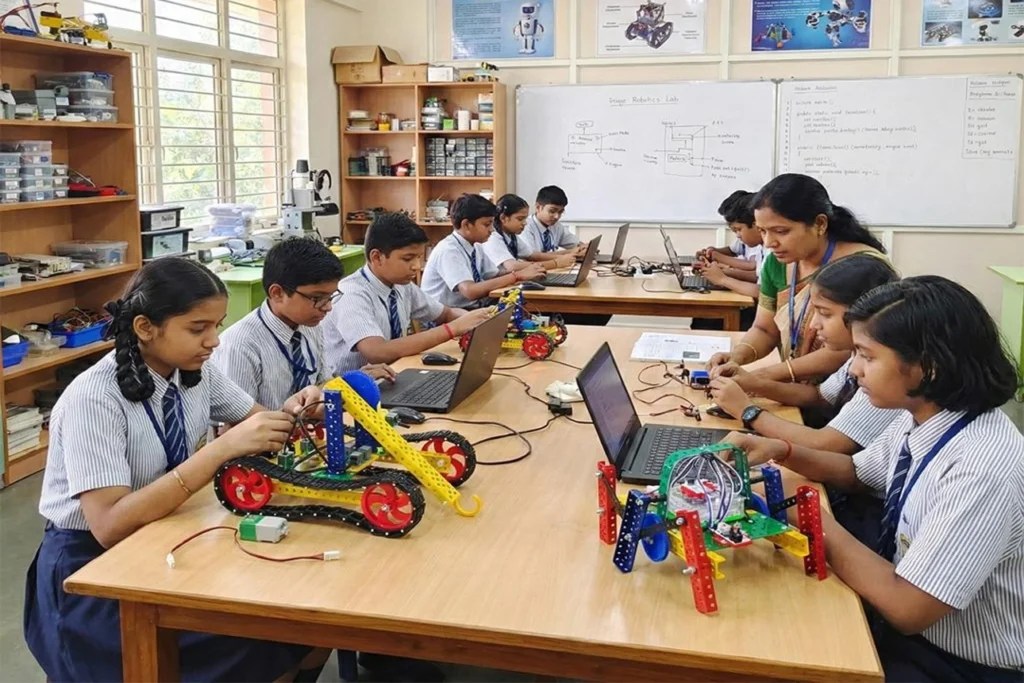
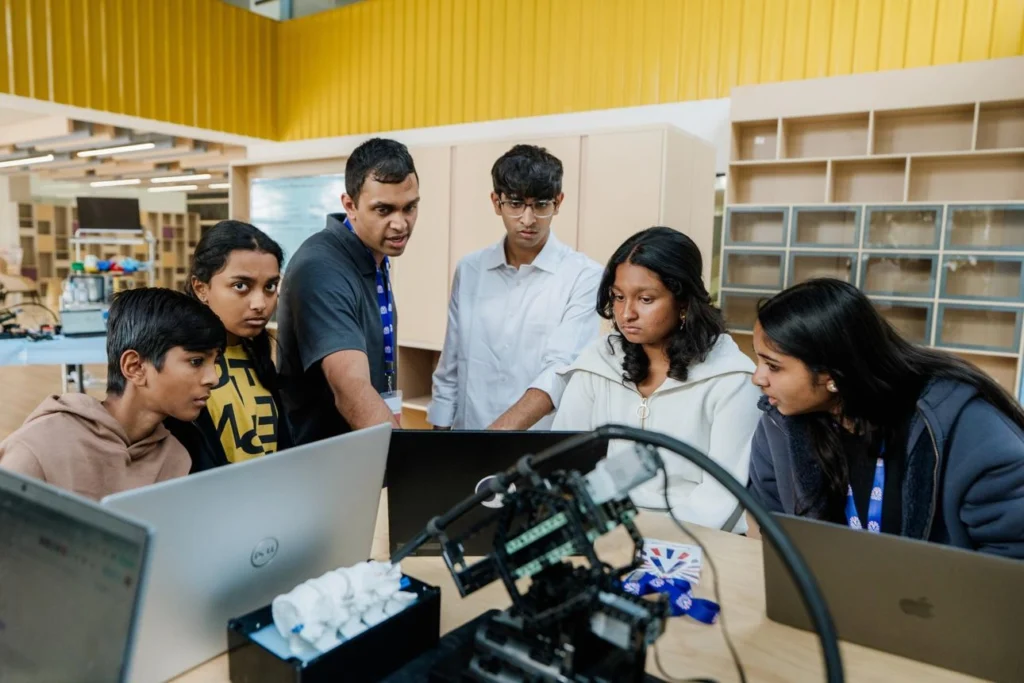
Robotics competitions
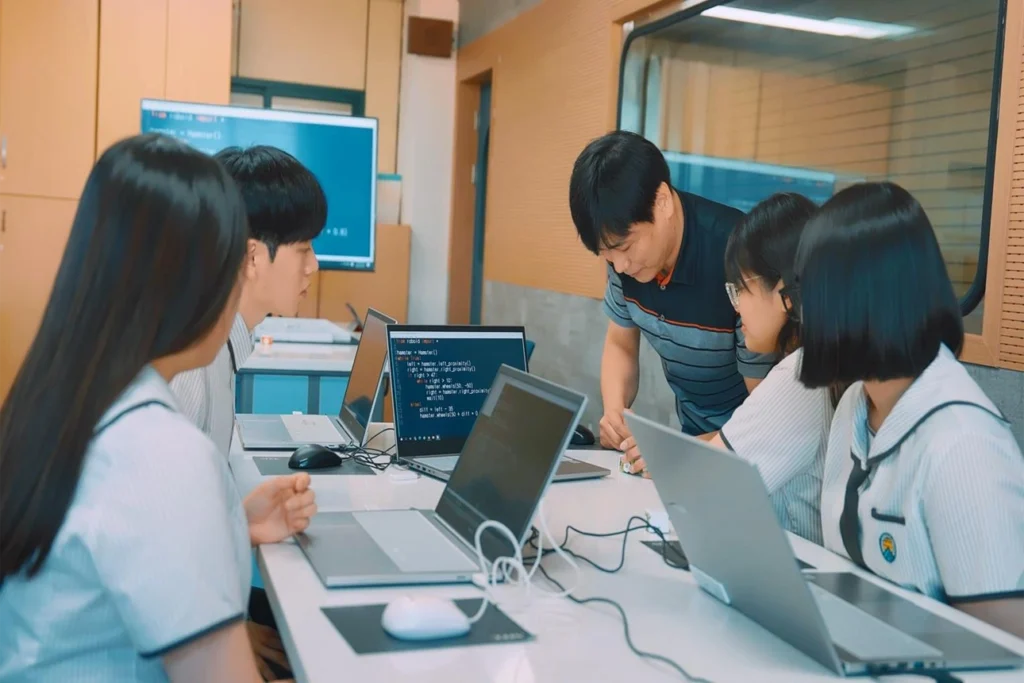
Coding and app development
Drone demonstrations
Bridge-building challenges
Renewable energy models
Water filtration projects
Artificial Intelligence experiments
Science exhibitions
3D model designing
Mathematics puzzles
Smart city prototypes
Weather monitoring systems
These projects encourage students to apply classroom concepts to solve practical problems.
How STEM Learning Happens
An effective STEM learning process follows several stages:
1. Identify a Real-World Problem
Students begin by observing challenges in daily life or their community.
2. Research the Topic
They collect information, understand scientific principles, and explore possible solutions.
3. Design a Solution
Students create models, diagrams, prototypes, or computer programs.
4. Build and Test
Projects are constructed, tested, evaluated, and improved through experimentation.
5. Present Findings
Students explain their ideas, share results, and learn from peer feedback.
This inquiry-based approach builds confidence and encourages independent thinking.
Benefits of STEM Education
Students participating in STEM programs gain several long-term advantages:
Better academic performance
Improved innovation skills
Stronger logical reasoning
Greater confidence in technology
Enhanced communication abilities
Increased curiosity
Better teamwork
Higher career readiness
Strong research skills
Practical application of classroom learning
These benefits extend beyond school into higher education and professional life.
Careers Inspired by STEM Education
STEM opens doors to numerous high-demand careers, including:
Artificial Intelligence Engineer
Robotics Engineer
Software Developer
Data Scientist
Aerospace Engineer
Environmental Scientist
Biomedical Engineer
Cybersecurity Specialist
Architect
Renewable Energy Expert
Game Developer
Research Scientist
Mechanical Engineer
Civil Engineer
Biotechnology Researcher
Students who develop STEM competencies are better prepared for the careers of tomorrow.
STEM Education at DWPS Kalyani
At DWPS Kalyani, STEM learning is integrated into the curriculum through practical experiences, innovation challenges, science laboratories, coding sessions, project-based learning, and technology-enabled classrooms.
Students participate in:
Science fairs
Robotics workshops
Coding clubs
STEM competitions
Innovation challenges
Environmental projects
Mathematics Olympiads
Technology exhibitions
Collaborative research activities
These opportunities help students become confident, creative, and future-ready learners.
How Parents Can Encourage STEM Learning
Parents play an important role in nurturing curiosity.
Simple ways to support STEM learning include:
Encourage children to ask questions
Explore science museums
Build simple models at home
Introduce educational coding platforms
Read science magazines together
Participate in nature observations
Support creative experiments
Discuss technological innovations
These experiences reinforce classroom learning and inspire lifelong curiosity.
Conclusion
STEM Education and Future Skills empower students to think creatively, solve complex problems, and adapt to an ever-changing world. By combining scientific knowledge with practical application, STEM prepares learners for higher education, emerging careers, and responsible global citizenship.
At Delhi World Public School Kalyani, we are committed to creating a learning environment where innovation, curiosity, and technology come together. Through experiential learning and future-focused education, we prepare students not only to succeed academically but also to become the innovators, scientists, engineers, and leaders of tomorrow.
Frequently Asked Questions
What is STEM Education?
STEM Education integrates Science, Technology, Engineering, and Mathematics through practical learning and real-world problem-solving.
Why are future skills important for students?
Future skills such as creativity, coding, communication, and critical thinking help students adapt to technological advancements and future careers.
What activities are included in STEM education?
Robotics, coding, engineering projects, science experiments, AI activities, innovation challenges, and mathematics applications are common STEM activities.
How does STEM Education benefit students?
STEM improves analytical thinking, creativity, collaboration, leadership, and prepares students for higher education and modern careers.
How does DWPS Kalyani promote STEM learning?
DWPS Kalyani encourages STEM education through science laboratories, robotics, coding, project-based learning, innovation challenges, competitions, and technology-enabled classrooms.